
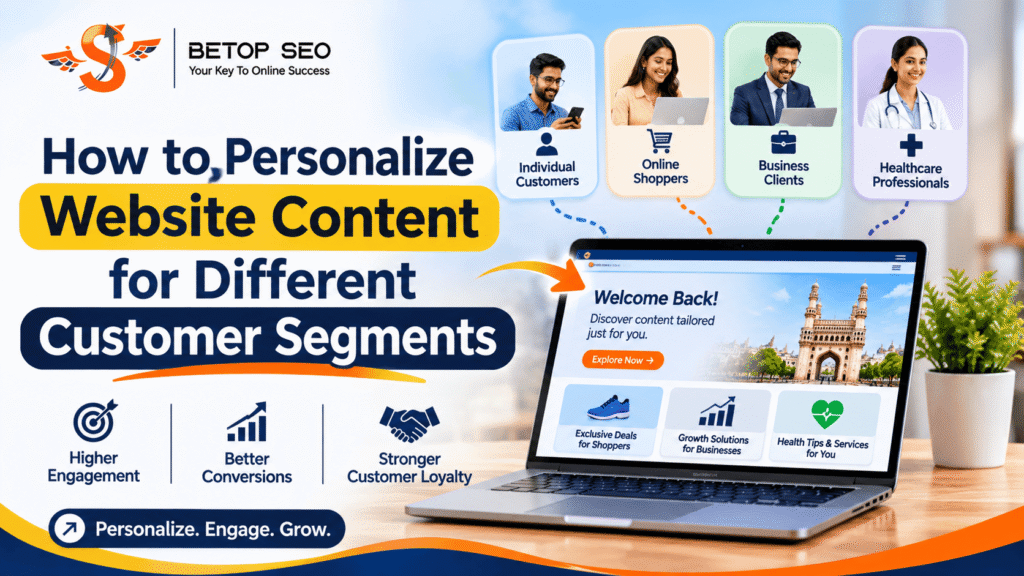
Website content personalization means showing relevant messages, recommendations, offers or information to visitors based on factors such as their interests, location, browsing behaviour and customer journey. Instead of presenting every visitor with exactly the same experience, businesses can use customer segments to make website content more useful and improve the likelihood of enquiries, registrations or purchases.
A first-time visitor researching a service may need educational information, while an existing customer may want product support or a new offer. Personalization helps businesses address these different needs without making the website confusing or difficult to navigate.
Why Is Website Personalization Important?
Customers visit websites with different expectations. Some are comparing providers, some are researching a problem, and others are ready to buy.
A generic website may not answer every visitor’s immediate question. Personalised content can make relevant information easier to find.
For example, an ecommerce website may highlight sports shoes to a visitor browsing fitness products. A B2B service provider may show a manufacturing case study to visitors exploring industrial solutions.
The purpose is not to track every user or make assumptions about individuals. It is to organise useful content around relevant customer needs.
1. Identify Your Main Customer Segments
Start by understanding the different groups that visit your website.
Common segmentation methods include:
Demographic segmentation: Age range, occupation or other relevant audience characteristics, where lawfully collected and appropriate.
Geographic segmentation: City, region or service location.
Behavioural segmentation: Pages visited, products viewed, downloads and previous interactions.
Customer lifecycle segmentation: First-time visitors, returning visitors, existing customers and repeat buyers.
Intent-based segmentation: Visitors researching a topic, comparing solutions or showing purchase intent.
For example, a digital marketing agency may identify three broad groups: small business owners looking for affordable marketing support, established companies seeking SEO growth and businesses interested in paid advertising.
Each group may need different information before contacting the agency.
2. Create Content for Each Segment
Once the segments are defined, map the questions and information needs of each group.
| Customer segment | Useful website content |
| First-time visitors | Company introduction, service overview and benefits |
| Research-stage visitors | Guides, FAQs and educational articles |
| Comparison-stage visitors | Case studies, pricing information and comparisons |
| Ready-to-buy visitors | Consultation forms, clear offers and contact details |
| Existing customers | Support resources, updates and relevant additional services |
Content should be genuinely useful rather than simply changing a headline to include a visitor’s location.
A structured content strategy also makes it easier to create the right page for each audience. Businesses can explore BeTopSEO’s content writing services in Hyderabad for support with service pages, landing pages and educational articles.
3. Use Location-Based Personalization Carefully
Location can help businesses display relevant information when they serve multiple regions.
For example, a company operating in Hyderabad and Bengaluru may highlight the relevant service area or local contact information when a visitor selects a location.
A good location-personalization strategy should:
- Clearly identify the service areas.
- Show accurate contact information.
- Provide relevant local case studies.
- Explain location-specific availability.
- Allow visitors to change their selected location.
Do not assume that every visitor in a city wants the same product or service. Location is only one possible indicator of relevance.
4. Personalize Content Based on Website Behaviour
Website behaviour can help identify what information a visitor may need next.
For example:
- A visitor reading an SEO guide may be interested in an SEO audit.
- Someone viewing several product pages may benefit from a product comparison.
- A visitor downloading a technical guide may want a related consultation.
- A returning customer may need support or account information.
Use these signals to recommend relevant resources, not to overwhelm users with repeated pop-ups.
Where tracking technologies or personal data are involved, provide appropriate transparency and obtain consent where required.
5. Use Dynamic Content and Personalised Calls to Action
Dynamic content allows parts of a website to change according to defined rules or user preferences.
Examples include:
- Showing a relevant case study on a service page
- Recommending related articles
- Displaying a location-specific contact option
- Highlighting a product category based on selected interests
- Showing a suitable next step for returning customers
Calls to action can also reflect the visitor’s stage in the buying journey.
A research-stage visitor may respond better to “Read the Complete Guide”, while a visitor comparing services may prefer “Request a Consultation”.
A well-organised website makes these experiences easier to implement. Explore website design and development services to understand how site structure and user experience support conversions.
6. Use Analytics to Evaluate Performance
Personalization should be tested rather than assumed to work.
Monitor:
- Conversion rate by audience segment
- Engagement with recommended content
- Enquiry form completion
- Product and service page visits
- Return visits
- Revenue or qualified leads
- Performance of different calls to action
Use A/B testing when possible. For example, compare a general service-page CTA with a segment-specific CTA and measure which produces more qualified enquiries.
Avoid treating a small change in clicks as proof of business impact. Evaluate lead quality and the complete customer journey.
7. Connect Personalization With Your Wider Marketing Strategy
Website personalization should not operate independently from SEO, advertising and content marketing.
For example, a visitor who discovers a business through a search result should find a landing page that directly answers the original query. A visitor arriving through an advertisement should see content consistent with the advertisement’s message.
Explore BeTopSEO’s digital marketing services and SEO services to see how website content fits into a wider customer acquisition strategy.
Frequently Asked Questions
- What is website content personalization?
It is the practice of adapting website content, recommendations or calls to action to match the needs and interests of different visitor groups.
- Does website personalization improve conversions?
It can improve relevance and reduce friction, but results depend on the quality of segmentation, content and user experience. Businesses should test its impact.
- What data is needed for website personalization?
Depending on the use case, businesses may use selected preferences, page interactions, purchase history, location and customer lifecycle information. Data collection must follow applicable privacy requirements.
- Can small businesses personalise website content?
Yes. Small businesses can begin with simple approaches such as service-specific landing pages, relevant case studies, location pages and tailored calls to action.
- Which tools can help with website personalization?
Website analytics platforms, content management systems, CRM platforms and marketing automation tools can support segmentation and personalised experiences. The right tools depend on the website and business requirements.
Final Thoughts
Website personalization helps businesses move beyond one-size-fits-all communication. By understanding customer segments, creating relevant content and testing performance, businesses can make their websites more useful at every stage of the buying journey.
Start with a few clear audience groups and meaningful content improvements. Expand personalization only when the data shows that it benefits customers and business performance.