
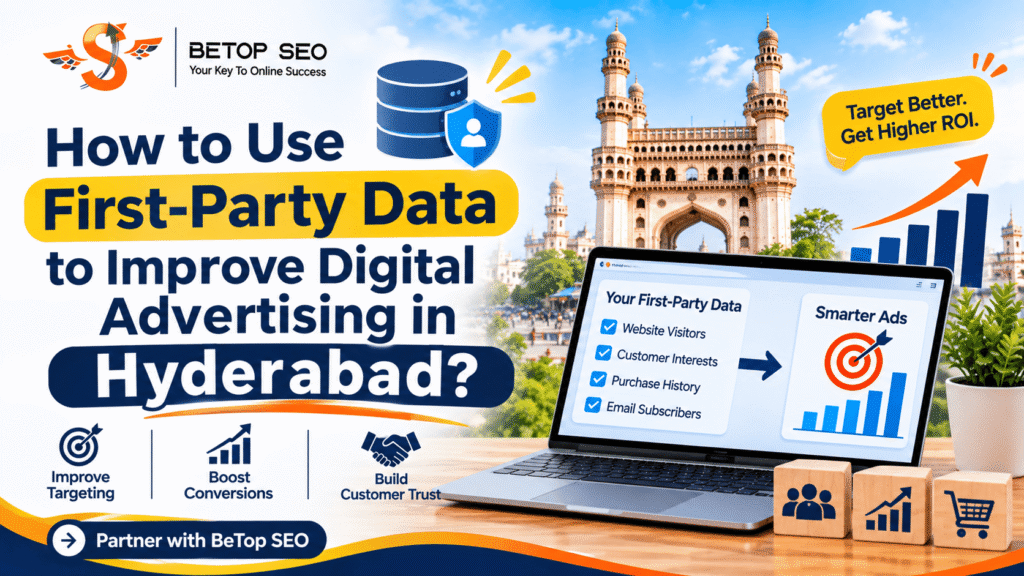
First-party data helps businesses improve digital advertising by using information collected directly from their customers and website visitors, such as enquiry details, purchase history, subscriptions and customer preferences. When collected transparently and used with appropriate consent, this data can support audience segmentation, relevant advertising, conversion measurement and customer retention.
For businesses in Hyderabad, first-party data can make advertising more relevant by connecting campaign decisions with real customer interactions rather than relying only on broad assumptions about an audience.
What Is First-Party Data?
First-party data is information a business collects directly through its own customer relationships and digital channels.
Examples include:
- Website enquiry form submissions
- Customer email addresses provided for a stated purpose
- Purchase and transaction records
- Newsletter subscriptions
- Product preferences
- Customer service interactions
- Loyalty programme information
- Appointment and booking records
For example, an ecommerce business in Hyderabad may know which product categories a customer has purchased. A B2B company may have records of businesses that requested product catalogues.
This information can help businesses understand customer needs and plan more relevant marketing communication.
Why Is First-Party Data Important for Digital Advertising?
Advertising platforms offer different audience and measurement features, but businesses should not depend entirely on data they cannot control.
First-party data can help a company:
- Understand existing customers.
- Identify high-value customer segments.
- Re-engage eligible previous customers.
- Improve conversion measurement.
- Reduce irrelevant advertising.
- Support customer retention.
- Connect marketing activity with actual sales.
Google’s Enhanced Conversions documentation explains how eligible first-party customer information can be hashed and used to improve conversion measurement. Businesses must still follow Google’s requirements and applicable consent rules.
1. Identify Where Your Business Collects Data
Begin by reviewing the customer information already available across your business.
Potential sources include:
- Website forms
- CRM systems
- Ecommerce platforms
- Appointment booking systems
- Email subscriptions
- Customer support records
- Offline sales and loyalty programmes
Create a simple inventory that explains what data is collected, why it is collected, where it is stored and who can access it.
Do not collect extra personal information simply because a marketing platform allows it.
A well-structured website can make it easier to capture relevant enquiries. Explore BeTopSEO’s website design and development services for support with website structure and enquiry journeys.
2. Organise Data Into Useful Customer Segments
Raw customer information becomes more valuable when it is organised around meaningful business categories.
For example, an ecommerce business might create segments for:
- First-time purchasers
- Repeat customers
- Customers interested in a specific product category
- Customers who have not purchased recently
- Customers who subscribed to product updates
A Hyderabad-based B2B manufacturer might segment contacts by industry, product interest, enquiry stage and distributor status.
These segments can support different messages. A first-time customer may need product education, while an existing customer may be interested in complementary products or service updates.
3. Use First-Party Data in Google Ads
Google Ads offers Customer Match, which allows eligible advertisers to use first-party customer information for audience-related advertising features across supported Google surfaces.
Businesses can use eligible customer data to reconnect with customers, promote relevant products or support customer acquisition strategies.
Google requires advertisers to follow its Customer Match policies, including rules about the source of customer information and applicable consent requirements.
Before uploading customer data:
- Confirm that the information was collected directly and lawfully.
- Check that the intended use is covered by the relevant notice and consent.
- Follow the platform’s data-format and eligibility rules.
- Secure access to customer lists.
- Exclude customers where appropriate.
Audience availability and targeting features can depend on account eligibility and platform policies.
Explore BeTopSEO’s Google Ads services and paid advertising services for support with campaign planning and optimisation.
4. Improve Conversion Tracking
Advertising campaigns should be measured using actions that matter to the business.
Examples include:
- Completed purchases
- Qualified enquiry submissions
- Appointment bookings
- Phone calls
- Catalogue requests
- Paid subscriptions
Use Google Analytics 4, Google Ads conversion tracking and a suitable CRM process to connect campaign activity with business outcomes.
Enhanced conversions may improve measurement by using eligible, consented first-party data in a privacy-conscious way. They do not remove the need for accurate tracking configuration or user consent.
5. Use First-Party Data for More Relevant Advertising
Different customer groups may need different messages.
For example, a customer who previously purchased a laptop may be interested in accessories. A person who requested a quotation for industrial equipment may need a follow-up about specifications or installation support.
A business can use suitable customer segments to make advertisements more relevant, provided the data and advertising use comply with applicable policies.
Avoid repeatedly advertising products customers have already purchased when the message is no longer useful.
6. Connect Advertising Data With CRM and Sales
Advertising platforms show campaign activity, but the sales team often has the information needed to judge lead quality.
A CRM can help track:
- Lead source
- Product or service interest
- Enquiry date
- Sales qualification status
- Follow-up activity
- Deal outcome
- Customer value
This helps businesses distinguish between campaigns that generate many enquiries and campaigns that generate actual sales opportunities.
For example, two Google Ads campaigns may generate the same number of forms, but one may produce more qualified enquiries. CRM feedback helps identify that difference.
Businesses can also explore BeTopSEO’s lead generation guide for related strategies to attract and manage enquiries.
7. Protect Customer Data
First-party data is valuable only when customers trust the business collecting it.
Follow these practices:
- Explain what information is collected and why.
- Obtain consent where required.
- Provide appropriate opt-out options.
- Limit access to authorised staff.
- Store data securely.
- Follow retention and deletion policies.
- Respect advertising platform requirements.
Frequently Asked Questions
- What is first-party data in digital marketing?
It is information a business collects directly from customers or users through its own website, app, transactions, subscriptions or interactions.
- How does first-party data improve Google Ads?
Eligible first-party data can support Customer Match audience features and enhanced conversion measurement, subject to Google’s policies and applicable consent requirements.
- Is first-party data better than third-party data?
First-party data offers direct insight into a business’s own customer relationships. It is not automatically better for every use case, but it can provide valuable context and more control over collection and use.
- Can small businesses use first-party data?
Yes. Even a small business can begin with consented enquiry records, customer subscriptions, purchase history and a simple CRM.
- Does using first-party data remove privacy obligations?
No. Businesses must still comply with applicable privacy laws, platform policies, transparency requirements and consent obligations.
Final Thoughts
First-party data can help Hyderabad businesses make advertising more relevant, improve measurement and understand which campaigns create real business value. The best approach is to collect only useful information, organise it responsibly and connect it with advertising and sales performance.
A privacy-conscious data strategy can help businesses build stronger customer relationships while making more informed marketing decisions. Explore BeTopSEO’s digital marketing services to learn more about improving campaign performance.