
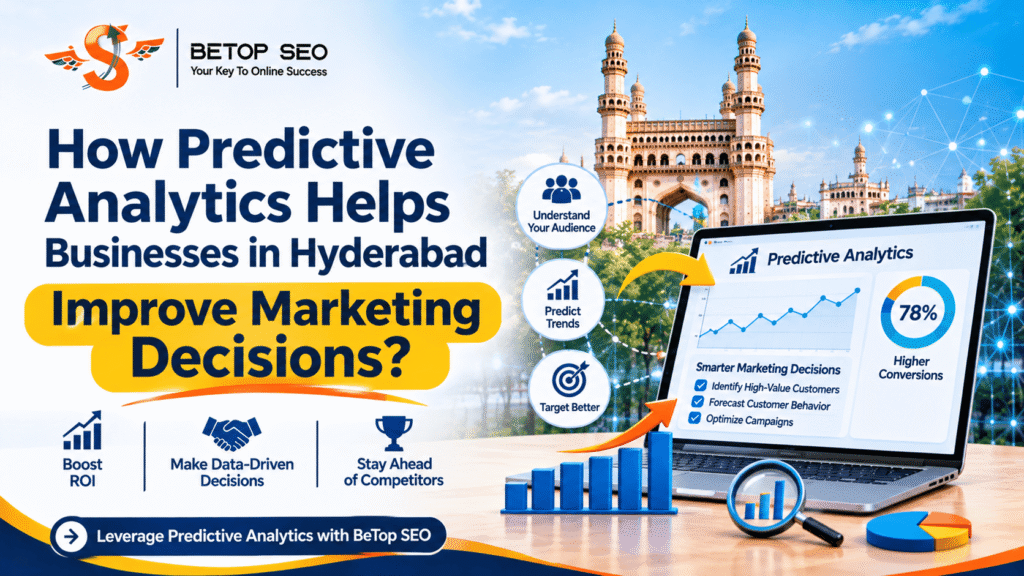
Predictive analytics helps businesses in Hyderabad make better marketing decisions by analysing historical data, identifying patterns and estimating what customers may do in the future. It can support demand forecasting, customer segmentation, lead scoring, campaign planning and customer retention. Instead of relying only on assumptions, businesses can use data-based predictions to decide where to focus their marketing resources.
For example, an ecommerce business may analyse previous purchases to estimate which products could attract demand during a seasonal campaign. A service company may study past enquiries to identify which lead characteristics are associated with successful conversions.
Predictive analytics does not guarantee that a forecast will happen. Its value comes from helping businesses make more informed decisions while continuing to monitor actual results.
What Is Predictive Analytics in Marketing?
Predictive analytics uses historical and current data, statistical techniques and machine learning models to estimate future outcomes.
In marketing, it can help answer questions such as:
- Which customers may be more likely to purchase?
- Which products could see increased demand?
- Which leads should the sales team prioritise?
- Which customers may stop engaging?
- Which campaigns may perform better?
- When should a business increase or reduce promotional activity?
Predictive analytics can support marketing teams in identifying customer behaviour patterns, improving lead scoring, forecasting trends and planning campaigns.
Why Is Predictive Analytics Useful for Hyderabad Businesses?
Businesses across Hyderabad operate in different markets, from retail and ecommerce to healthcare, education, real estate, manufacturing and professional services.
Each industry has different customer behaviour and buying cycles.
A retail business may need to forecast seasonal demand. An educational institute may want to estimate which enquiries are more likely to become admissions. A B2B manufacturer may need to prioritise enquiries based on product requirements and sales history.
Predictive analytics can help these businesses use available information more effectively.
1. Forecast Customer Demand
Demand forecasting helps businesses estimate which products or services may be needed in a future period.
A retailer can review previous sales, seasonal trends and promotional performance to plan inventory and advertising.
For example, a Hyderabad clothing store may analyse past festive-season sales to estimate which categories could attract more interest during the next festive period.
The forecast can support decisions about inventory, campaign budgets and product promotion.
However, historical trends are not guarantees. Competitor activity, economic conditions, pricing and unexpected events can affect actual demand.
2. Improve Customer Segmentation
Traditional segmentation often groups customers using basic information such as location, age range or purchase category.
Predictive analytics can add another layer by identifying patterns in customer activity.
Possible segments include:
- Customers likely to make repeat purchases
- Customers who may respond to a particular offer
- Customers who have reduced engagement
- Customers interested in a specific service
- Customers who may need additional information before buying
For example, an ecommerce company may identify customers who regularly purchase a particular category and create a relevant product campaign.
Use these predictions responsibly and avoid making sensitive or unsupported assumptions about individuals.
3. Improve Lead Scoring and Sales Prioritisation
Businesses often receive enquiries from multiple sources, but not every enquiry has the same likelihood of converting.
Predictive lead scoring uses available historical data to estimate which leads may be more likely to become customers.
Useful data may include:
- Enquiry source
- Service or product interest
- Previous interactions
- Website activity
- Lead response history
- Sales qualification status
- Previous conversion patterns
A B2B service company in Hyderabad could use this information to help its sales team prioritise enquiries that match its ideal customer profile.
Lead scores should support sales judgement, not replace it. Teams should regularly check whether predictions are accurate and fair.
Businesses can complement this process with a structured lead generation strategy that connects marketing enquiries with sales follow-up.
4. Optimise Advertising Campaigns
Predictive analytics can help marketers evaluate campaign patterns and allocate budgets more intelligently.
For example, a business may compare historical performance across:
- Search keywords
- Audience groups
- Advertising channels
- Geographic locations
- Campaign periods
- Landing pages
This can help identify which combinations are associated with better lead quality or conversion rates.
Google Ads also uses automated bidding and machine learning features to optimise campaigns based on available signals and selected objectives. Businesses should still configure accurate conversion tracking and evaluate performance against actual business outcomes.
Explore BeTopSEO’s Google Ads services and paid advertising solutions for campaign support.
5. Identify Customers at Risk of Leaving
Customer retention is important for businesses that depend on repeat purchases, subscriptions or ongoing services.
Predictive models may identify patterns associated with reduced engagement, such as fewer purchases, longer gaps between visits or declining interaction.
A business can use these signals to review customer experience and plan relevant communication.
For example, an online subscription service may contact customers whose usage has reduced, offering support or explaining useful features.
Do not automatically assume that a customer intends to leave. Predictions should prompt appropriate review rather than intrusive communication.
6. Measure and Improve Marketing Performance
Predictive analytics becomes more useful when businesses compare forecasts with actual outcomes.
Track metrics such as:
- Forecast accuracy
- Qualified leads
- Conversion rates
- Customer acquisition cost
- Repeat purchase rate
- Campaign revenue
- Customer retention
- Return on advertising spend
Use a CRM, website analytics and advertising data to build a more complete view of the customer journey.
The quality of the prediction depends on the quality of the underlying data. Missing, outdated or inconsistent information can produce misleading results.
A connected SEO strategy and digital marketing strategy can help businesses measure performance across organic and paid channels.
7. Start With a Practical Predictive Analytics Process
Businesses do not need a complex AI system to begin.
A practical starting process is:
- Define one business question, such as which leads are most likely to convert.
- Identify the relevant data sources.
- Check data quality and permissions.
- Establish a baseline using historical performance.
- Build or select an appropriate forecasting method.
- Compare predictions with actual outcomes.
- Improve the model and decision process over time.
For smaller businesses, a well-organised spreadsheet or CRM report may be sufficient for an initial analysis. More advanced modelling can be considered as data volume and business requirements grow.
Frequently Asked Questions
- What is predictive analytics in digital marketing?
It is the use of historical and current data to estimate future customer behaviour, demand, lead quality and campaign outcomes.
- How does predictive analytics help businesses?
It can support better forecasting, customer segmentation, lead prioritisation, campaign planning and retention strategies.
- Can small businesses use predictive analytics?
Yes. Small businesses can begin with sales history, website analytics and CRM data before investing in advanced predictive tools.
- Is predictive analytics the same as AI marketing?
No. Predictive analytics is one application of data analysis and may use machine learning or AI. AI marketing is a broader field that includes content assistance, automation, personalisation and other capabilities.
- Are predictive analytics results always accurate?
No. Predictions depend on data quality, model design and changing market conditions. Businesses should compare forecasts with actual outcomes and update their approach regularly.
Final Thoughts
Predictive analytics helps Hyderabad businesses move from reactive marketing decisions towards more informed planning. By analysing customer behaviour, forecasting demand and identifying useful patterns, businesses can make better decisions about budgets, audiences and campaigns.
The best starting point is a clear business question and reliable data. Predictions should guide decisions—not replace experience, customer understanding or ongoing measurement.