
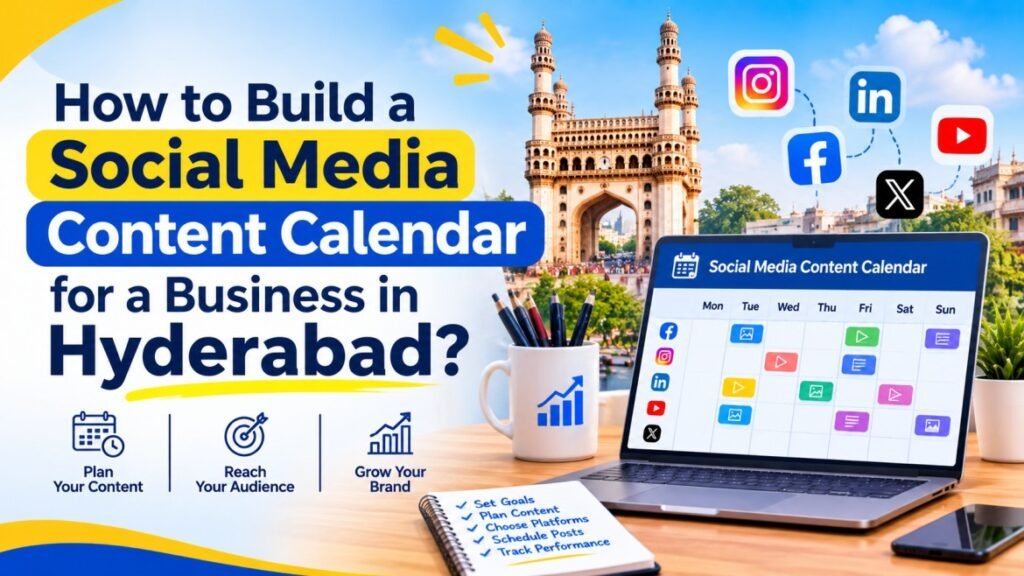
A practical social media content calendar for a business in Hyderabad should connect every post to a business goal, a specific audience and a clear next step. Start by choosing the platforms your customers actually use, define three to five content themes, plan a realistic weekly posting rhythm, and schedule a mix of educational, proof-based, product and local content. Review performance every month and use the results to improve the next calendar.
| Quick answer
A good calendar is more than a list of dates. It records the target audience, content pillar, format, key message, call to action, owner, approval status, publishing channel and success metric for each post. For a small business, three purposeful feed posts a week can be a better starting point than daily posts that are rushed or repetitive. |
Why Hyderabad businesses need a planned social media calendar?
When social media is handled only when someone has spare time, the pattern is familiar: a few posts go live during a festival or promotion, the page goes quiet, and the next post is written in a hurry. A calendar solves this operational problem. It helps the business publish consistently, balance promotional posts with genuinely useful information, and prepare campaigns before important dates.
There is also a large national audience opportunity. DataReportal’s Digital 2027 India report estimates 573 million social media user identities in India in October 2026. The same report cites an Instagram advertising audience of around 515 million in India in late 2026. These figures are not unique-user counts and are not Hyderabad-specific, but they show why social content can play a meaningful role in how people discover brands and research products. [1]
Local relevance is what makes a calendar useful. A restaurant in Jubilee Hills, a pet hospital in Jeedimetla, a coaching institute in Ameerpet and a B2B manufacturer in Balanagar do not need the same topics, formats or calls to action. A good calendar reflects the business’s customers, service area, buying cycle and capacity to create content.
Step 1: Decide what social media must achieve
Choose one primary objective for the next 60–90 days. Supporting objectives are fine, but a calendar becomes unfocused when every post is expected to generate awareness, engagement, enquiries and sales at once.
- Local awareness: reach people who live, work, study or shop near the business.
- Trust and consideration: explain the service, show expertise, answer objections and demonstrate the experience.
- Lead generation: encourage a consultation, WhatsApp enquiry, trial, booking or quote request.
- Sales and repeat business: promote products, seasonal collections, new menu items, offers and loyalty activity.
- Community: encourage reviews, customer stories, questions, user-generated content and local participation.
Choose a metric for the objective. For awareness, look at relevant reach and video views. For education and trust, review saves, shares, meaningful comments, profile actions and return visits. For leads, measure enquiries and qualified enquiries. For sales, connect content and campaigns to orders or revenue where tracking permits.
Step 2: Understand your Hyderabad audience before choosing topics
Write a simple audience profile for each major customer group. Include the problem they are trying to solve, what makes them hesitate, what proof they need, the locations they come from and the language in which they prefer to consume information. Use actual customer conversations, sales questions, reviews, enquiry forms and staff observations rather than relying only on assumptions.
For a local service business, geography can shape content. A clinic may need directions, parking details and doctor introductions. A restaurant may feature lunch options for nearby offices as well as weekend family dining. A property brand may need commute context, project walkthroughs and clear information about approvals and amenities. A B2B manufacturer may need process videos, quality documentation and buyer-focused explainers rather than consumer-style trends.
Test English, Telugu or bilingual captions based on customer response. Do not assume language preference from a neighbourhood or age group. Use subtitles for spoken videos and make the key message understandable even when the video is watched without sound.
Step 3: Choose only the platforms you can maintain well
A business does not need to publish on every platform. Choose channels based on customer behaviour and the team’s ability to create suitable content.
- Instagram: visual discovery, Reels, product demonstrations, behind-the-scenes content, customer stories and creator collaborations.
- Facebook: local community visibility, events, offers, customer interaction and audiences who actively use Facebook.
- LinkedIn: B2B expertise, company updates, leadership perspectives, hiring, project capability and professional trust.
- YouTube: searchable explainers, demonstrations, interviews, testimonials and longer videos that answer detailed questions.
- WhatsApp: direct service conversations, updates and opt-in customer communication. Treat it as a relationship channel, not a place to send unsolicited promotional messages.
Instagram provides a Best Practices area inside the Professional Dashboard, covering creation, engagement, reach, monetisation and guidelines, with account-specific guidance. Make it part of the monthly review rather than relying on outdated universal rules about ideal posting times or hashtag counts. [2]
Step 4: Create three to five repeatable content pillars
Content pillars are recurring themes that make planning easier while keeping the page useful. A balanced starting mix for many local businesses could look like this:
| Content pillar | What to publish |
| Educational / helpful (35–40%) | Answer customer questions, explain processes, share checklists and correct common misunderstandings. |
| Proof and trust (20–25%) | Show case examples, testimonials with permission, staff expertise, reviews, project progress and customer stories. |
| Product or service (20%) | Explain services, features, packages, menus, product benefits, availability and how to buy. |
| People and process (10–15%) | Introduce the team, show how work is done, share behind-the-scenes moments and answer FAQs. |
| Local and seasonal (5–10%) | Connect to relevant Hyderabad events, local needs, community activity and seasonal buying moments. |
These percentages are an editorial starting point, not an algorithm rule. A new restaurant may need more product and location content before opening; a specialist B2B company may need more educational material and proof. Adjust the mix according to the business objective and audience response.
Step 5: Pick a realistic posting rhythm
Consistency matters, but consistency does not mean publishing every day. Start with a schedule the team can sustain for at least eight to twelve weeks. For many small businesses, a useful starting point is three feed posts per week, supported by Stories or short updates on days when there is something relevant to share. A B2B company may prefer two strong LinkedIn updates each week and one deeper monthly article or video.
Think in formats as well as topics. Use short vertical videos to demonstrate, carousels to teach a process, static visuals for important information, Stories for timely updates and longer video for detailed explanations. Reuse the same idea in a format that suits each platform instead of copying the exact same post everywhere.
A sample weekly social media calendar for a Hyderabad business
| When | Purpose | Example post | What to measure |
| Monday | Helpful explainer | Carousel: “5 questions to ask before choosing [service] in Hyderabad” | Saves, shares, profile visits |
| Wednesday | People / process | Reel: a team member shows how the service or product works | Watch time, shares, comments |
| Friday | Proof / offer | Customer story, project walkthrough or clearly explained offer | Qualified DMs, calls, bookings |
| Stories (as relevant) | Community / updates | Poll, FAQ, availability, behind-the-scenes or event reminder | Replies, taps, enquiries |
This is a reusable structure, not a rule that every business must follow. A bakery can replace the Friday post with a weekend special; an interior-design studio can show a completed project; a coaching centre can publish a student question or course explainer; a manufacturer can demonstrate a process or explain a quality standard.
Step 6: Turn the weekly rhythm into a 30-day content plan
Plan one month at a time, leaving room for timely updates. A four-week plan for a local service brand could look like this:
| Week | Theme and content ideas |
| Week 1 – Introduction | Founder or team introduction; service explainer; location and how to visit/contact. |
| Week 2 – Education | Three common customer questions; a simple how-to; a myth-versus-fact post. |
| Week 3 – Proof | Customer story with permission; project or service walkthrough; review response or FAQ. |
| Week 4 – Conversion | Offer or consultation post; comparison or buying guide; monthly recap and next-step CTA. |
For a Hyderabad calendar, add relevant local moments only when they fit the audience and product. Depending on the business, this may include Sankranti, Ramadan and Eid, Ugadi, Bonalu, Bathukamma, Independence Day, Dussehra or Diwali. Confirm dates each year, avoid treating every festival as a sales opportunity, and give the creative enough lead time. A restaurant, clothing store and B2B engineering firm will have very different reasons to participate.
Step 7: Build a calendar that the team can actually use
Use a spreadsheet or project-management tool with one row per post. Include these fields:
- Publish date and time; platform and format.
- Business objective, audience and funnel stage.
- Content pillar, topic, opening hook and key message.
- Caption, creative brief, asset link and call to action.
- Owner, review/approval status and scheduled/published status.
- Destination URL with UTM tracking where relevant.
- Result after publication: reach, views, saves, shares, comments, profile actions, enquiries or sales.
Set a monthly planning meeting and a short weekly check-in. Batch related tasks: brainstorm topics in one session, record several short videos together, design the carousel set, write captions and schedule approved posts. Keep a small reserve of evergreen content for weeks when a campaign, event or staff schedule changes.
A Hyderabad example: how a content system can support local discovery?
A useful local example comes from Pawfex Multispeciality Pet Hospital in Jeedimetla. In a case study published by its marketing provider, KLIQVO reports that the Instagram page grew from 16 followers in January 2026 to 612 in July 2026. The provider says the team published 29 Reels between January and June, covering the hospital, grooming, veterinary advice, pet-parent stories and trends. One Reel reportedly reached 1.1 million people and generated 10,800 shares. [3]
The case study also describes other activity: a new-hospital announcement, Meta ads that opened WhatsApp chats, Google Maps ads and a website. That context matters. The results should not be attributed to a content calendar alone, and the numbers are provider-published rather than independently audited. Still, the example shows a practical local content principle: repeat useful formats, feature real specialists, answer questions people genuinely ask and make it easy for nearby customers to find the service.
An illustrative example: a 30-day calendar for an interior-design studio
Imagine an interior-design studio serving Gachibowli, Kondapur and the Financial District. This is a planning example, not a real client case study. The studio could publish one project walkthrough each week, one educational carousel about budgets or materials, and one behind-the-scenes Reel showing site progress or a design decision. Stories could collect questions about modular kitchens, storage and project timelines. A monthly consultation post would invite people to share their project type, approximate timeline and preferred area.
This mix supports different stages of the buying journey: educational posts help people understand the process; project walkthroughs demonstrate capability; team content builds trust; and the consultation CTA gives interested people a clear next step. The studio should measure qualified project enquiries and consultations, not follower growth alone.
Step 8: Measure what happened and improve next month
At the end of each month, compare results with the objective you selected. A practical review might include:
- Reach and relevant audience growth: are local people discovering the page?
- Engagement quality: which posts earned saves, shares, meaningful comments or direct questions?
- Video performance: where do people stop watching, and which openings keep attention?
- Action: did people visit the profile, tap directions, click the website, send a message or call?
- Business result: how many enquiries were relevant, how many converted, and what revenue or repeat business followed?
Use tracking links for campaigns that send users to the website. Ask new enquiries how they heard about the business, and record the answer in the CRM. Review Instagram’s in-app Best Practices and account insights, but interpret platform metrics alongside real enquiries and customer feedback. [2]
Keep, adapt or stop content based on evidence. If educational carousels drive saves but few enquiries, add a relevant next step. If a Reel gets high reach but attracts people outside the service area, make the location and offer clearer. If customer stories generate meaningful questions, plan more of them—with permission.
Common social media calendar mistakes
- Planning around festivals and trending audio while forgetting the everyday questions customers ask.
- Making every post promotional and giving audiences no reason to save, share or return.
- Choosing too many platforms and posting low-quality duplicates everywhere.
- Using generic stock images when real people, products, premises and work would build stronger trust.
- Writing captions without a purpose or a clear next step.
- Treating follower growth and likes as the only measures of success.
- Scheduling content so far in advance that incorrect prices, dates, offers or availability remain live.
Frequently asked questions
How far in advance should a business plan social media content?
Plan the main themes and campaigns one month ahead, then review the calendar weekly. Keep space for timely updates, customer questions and relevant local events.
How often should a Hyderabad small business post on Instagram?
Start with a sustainable rhythm, such as three purposeful feed posts a week, and adjust based on production capacity and audience response. The best frequency is the one the business can maintain without sacrificing quality.
What should a business post when it has no new offers?
Answer FAQs, demonstrate the process, introduce the team, explain common mistakes, share customer stories with permission, show behind-the-scenes work and create useful local guides. Every post does not need a discount.
Should the same content be posted on Instagram, Facebook and LinkedIn?
The core idea can be reused, but adapt the format, caption, context and CTA for each platform. A project walkthrough may work as an Instagram Reel, a Facebook update and a more detailed LinkedIn case note, each written for its audience.
What is the most important metric for a social media calendar?
There is no single metric for every objective. Use reach for awareness, saves and shares for useful content, qualified enquiries for lead generation, and attributable revenue or repeat orders for sales-focused activity.
Final takeaway
A strong social media content calendar gives a Hyderabad business a clear reason to publish, a manageable workflow and a way to learn from every month. Start with your customers and business goals, choose the channels you can maintain, build a few repeatable content pillars, localise ideas thoughtfully and measure enquiries and sales alongside engagement. The aim is not to fill every date. It is to publish content that helps the right people understand, trust and choose the business.
local visibility and lead tracking—so social activity supports a wider growth strategy.BeTopSEO can help businesses connect social media planning with content creation, paid campaigns,
Sources and editorial notes
Sources are attributed to their publishers. Case-study figures are provider-reported, not independent industry benchmarks; enquiries and conversations are not necessarily sales.