
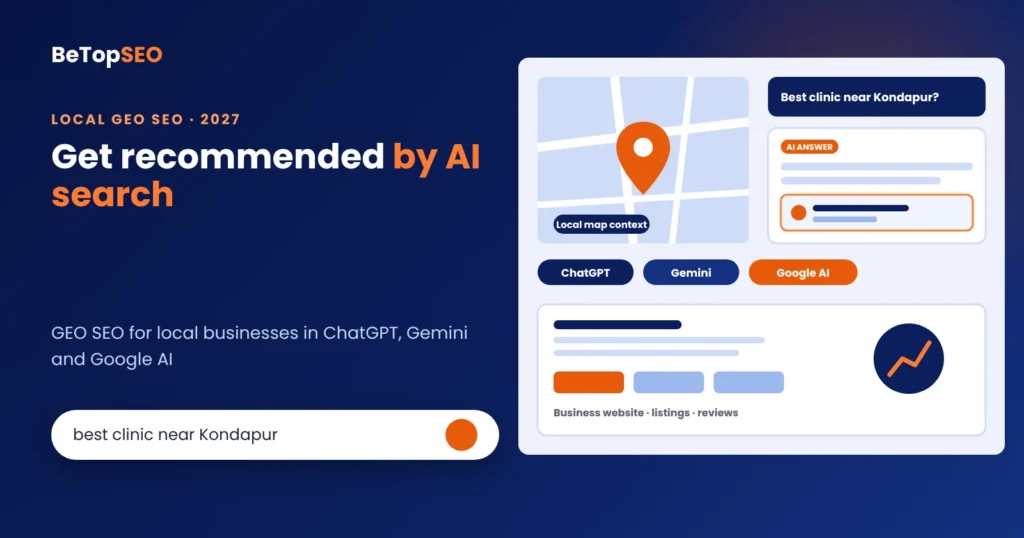
For a local business, GEO SEO means making your business easy for AI systems to understand, trust and mention when someone asks a question like “which dental clinic near Kondapur is good for braces” or “family restaurants in Banjara Hills with parking”. It builds on local SEO: the same accurate listings, useful pages and genuine reputation, presented clearly enough that a conversational assistant can work out who you are, what you do and where you do it.
People increasingly put these questions to ChatGPT, Gemini and Google’s AI features instead of typing short keywords and scanning ten links. The answer they receive is a summary that may name two or three businesses, cite a few sources and leave everyone else out. That is a different discovery path from a ranked list, and it rewards clarity and consistency over keyword tricks. This guide from BeTopSEO is written for owners and marketers of clinics, restaurants, real estate firms, schools, home service companies and professional practices, and it focuses on what a local business can actually do. For a complete introduction to the discipline, read our ultimate guide to Generative Engine Optimization first; here we concentrate on local implementation.
What Is GEO SEO?
GEO SEO applies generative engine optimisation to search visibility. Instead of only trying to rank a page for a keyword, you try to be a clear, credible source that AI systems can draw on when they generate an answer. Traditional SEO remains the foundation, because AI features still depend on content that is crawlable, indexed and trustworthy. Google says as much: for its AI Overviews and AI Mode, a page needs to be indexed and eligible to appear with a snippet, and no special markup or extra files are required, as its guidance on AI features and your website explains.
Four disciplines overlap here. Local SEO covers listings, maps and location relevance. Entity SEO makes sure systems recognise your business as a distinct, well-described thing. Answer engine optimisation (AEO) structures content so it answers questions directly, which we cover in our AEO guide. GEO is the umbrella that asks whether all of that adds up to being understood and referenced in AI-generated answers. Be aware that GEO strategies are newer and less proven than established SEO practice, and no one can promise a recommendation.
How ChatGPT, Gemini and Google AI Discover Local Businesses
Each assistant works differently, and none publishes a ranking formula, so be wary of anyone who claims to know one. What can be said is how the experiences generally behave. Users ask conversational, specific questions with a location and a need built in. The system searches or retrieves information, summarises it and sometimes names businesses with links to the sources it used.
OpenAI’s help documentation says ChatGPT search builds queries from a user’s prompt, may send disassociated queries to third-party search providers, and shows inline citations with a Sources list. It also says ChatGPT uses general location from the user’s IP address to improve results. Google’s AI features may run several related searches across subtopics and sources, which is why they can show a wider mix of links than classic search, and Google recommends keeping your Business Profile information current. Across all of them, the inputs that matter are your website, business listings, reviews, third-party mentions and the consistency between them. If those sources disagree, an assistant has less reason to trust any of them.
GEO SEO vs Traditional Local SEO
| Factor | Traditional local SEO | GEO SEO |
|---|---|---|
| Search intent | Short keyword plus location | Conversational, multi-part questions |
| Keyword optimisation | Target terms on pages | Cover topics and questions in natural language |
| Business entity information | Name, address and phone consistency | Clear identity, services, areas served and relationships |
| Google Business Profile | Core ranking asset in Maps | Key source of verified, current business facts |
| Website content | Service and location pages | Clear, answer-led pages with supporting detail |
| Reviews and reputation | Rating, volume and recency | Reputation and how customers describe you |
| Citations and brand mentions | Directory listings | Relevant mentions that confirm who you are |
| Structured data | Supports understanding of pages | Same role; no guarantee of citation |
| Visibility measurement | Rankings, map position, traffic | Mentions, citations, prompts and AI referrals |
| Customer journey | Search, compare, click | Ask, read a summary, then search or visit |
The two work together. A business with weak local foundations is unlikely to be described confidently by an AI, and a business with strong foundations still benefits from content and entity clarity. Treat GEO as a layer on top of local SEO, not a replacement for it.
10 GEO SEO Strategies for Local Businesses in 2027
Strategy 1: Build a clear and consistent business entity
Decide exactly how your business is described, then use it everywhere: the legal or trading name, address, phone number, website, categories and main services. Your website should carry an About page that explains who you are, where you operate and what you do, supported by organisation information and contact details that match your profile and listings. Small inconsistencies, such as an old phone number on a directory or two spellings of your name, add up to confusion for both people and systems.
Strategy 2: Optimise your Google Business Profile
Your profile is the most reliable source of verified local facts. Choose accurate categories, describe your services honestly, keep hours current including holiday changes, add real photographs and respond to reviews. Follow Google’s guidelines for representing your business, which cover accurate names, addresses and eligibility. Maintenance matters more than a one-time setup. Our guide to Google Business Profile and local SEO in India covers the steps, though no profile work can guarantee an AI recommendation.
Strategy 3: Create strong local service pages
Give each important service its own page that explains what you offer, who it is for, how it works, what customers should expect and how to reach you. Where you serve several areas, write a separate page for each real location with its own details, staff, parking or access notes, local requirements and frequently asked questions. Thin pages that swap one place name into identical text help nobody and invite duplicate-content problems, so create a location page only for a place where you genuinely operate. Connect these pages with sensible internal links, and see our local SEO service for how we structure this work.
Strategy 4: Develop helpful content around local questions
AI users ask things like which provider to choose in their area, what a service costs, which company offers a particular service in Hyderabad and what to check before hiring. Answer those questions on your site, starting with the direct answer and following with the detail. A page on how to choose an orthodontist, what affects the cost of a home renovation or how to compare coaching institutes in a locality serves customers first and gives AI systems clear material second. Avoid inventing prices or promises; where costs vary, explain what drives them. Professional SEO content writing helps when the knowledge is yours but the time is not.
Strategy 5: Strengthen reviews and reputation
Reviews tell customers what it is like to deal with you, and they are one of the facts people and systems can read about your business. Ask genuine customers for feedback after service, reply to every review calmly and specifically, and use complaints to fix problems. Never buy, fake or selectively filter reviews, and avoid incentives that break policy; Google restricts profiles for fake engagement, as its Business Profile restriction policy explains. A consistent reputation builds trust, but we cannot claim it directly changes what an AI says.
Strategy 6: Build relevant brand mentions and authority
Mentions from credible places confirm that your business is real and relevant: local business associations, industry bodies, reputable directories in your sector, local news, partners and suppliers, and events you genuinely take part in. Quality and relevance matter far more than quantity. Do not submit to hundreds of directories or buy backlinks; a few accurate, relevant listings and genuine mentions do more than a large volume of weak ones, and they keep your business information consistent.
Strategy 7: Implement appropriate structured data
Structured data labels the facts on your pages so search engines can read them reliably. For a local business the relevant types are LocalBusiness, using the most specific subtype that fits, Organization, Service, BreadcrumbList and Article or BlogPosting for editorial content. Google’s local business structured data documentation lists the recommended properties. FAQPage markup is harmless where visible questions and answers exist, though Google no longer shows FAQ rich results. Mark up only what visitors can see, avoid duplicate output from several plugins, and remember that schema helps understanding without guaranteeing rankings or citations. Our explainer on what schema markup is covers the basics.
Strategy 8: Improve technical SEO and accessibility
AI systems cannot use what they cannot reach. Make sure important pages are crawlable and indexable, internally linked, mobile-friendly and fast, with clean canonical tags, an accurate XML sitemap, correct titles and descriptions, compressed images and content that is available as text. Google specifically advises allowing crawling, keeping important content in text form and making pages findable through internal links. A technical SEO review checks these foundations.
Strategy 9: Establish topical authority in your local industry
Authority comes from covering your field thoroughly and consistently. A clinic might publish guides on common treatments, preparation and recovery written or reviewed by its doctors. A real estate firm can explain locality guides, registration steps and buying checklists. A restaurant can describe cuisines, dishes and event menus, and a professional practice can answer the questions clients ask most. Link these supporting articles to your service pages and keep the voice and facts consistent, so your site reads as one knowledgeable source. Our guide to semantic SEO explains how topic coverage builds meaning.
Strategy 10: Measure AI search visibility
Track a fixed set of customer-style prompts across the assistants, noting whether your business is mentioned, whether your pages are cited, which competitors appear and how you are described. Add AI referral traffic from your analytics, and watch leads and conversions, remembering that some visits arrive without referrer data. Treat each result as a sample, since answers vary between sessions and platforms. Review the findings monthly and adjust your content and profile accordingly.
- EntityGet your details right and consistent
- FoundationsProfile, pages and technical health
- ContentAnswer local questions clearly
- AuthorityReviews and relevant mentions
- MeasureTest prompts, review, improve
Practical GEO SEO Examples for Different Local Industries
Healthcare clinics
Patients ask things like which skin clinic near Gachibowli treats acne or what to expect from a first dental visit. Useful content includes treatment pages written with the doctors, doctor profiles with qualifications that can be verified, and FAQs on appointments and preparation. Entity details are the clinic’s exact name, specialties, address and hours, and local authority comes from professional associations and accurate listings. Improvements include removing outdated doctor information and linking treatments to the clinics that offer them; our guides to local SEO for clinics in Hyderabad and healthcare SEO go deeper.
Restaurants and cafes
Diners ask for family restaurants in Kukatpally or the best biryani near Banjara Hills. A restaurant needs a text menu, cuisine and dish pages, clear hours, ordering and reservation links and photographs of real dishes. Entity facts include cuisine type, price range, parking and dietary options. Reviews that mention specific dishes and local food mentions support authority, and a common fix is replacing a PDF or image menu with crawlable text.
Real estate companies
Buyers ask which builders are active in a micro-market or what to check before buying an apartment in Kondapur. Helpful content includes project pages with verified details, locality guides and buying checklists. Entity information covers the firm’s registered name, projects and RERA registration where applicable, and authority comes from verified listings and genuine press mentions. Avoid unverifiable claims; our real estate SEO page explains how we approach it.
Educational institutions
Parents and students ask which coaching institutes suit a particular exam or what a course includes. Useful content is course pages with syllabus, faculty and batch details, admission information and honest fee guidance. Entity details are the institution’s name, branches and courses offered, and authority comes from accreditation or affiliation information that can be verified. A frequent improvement is giving each course its own page instead of a single “Courses” list.
Home service providers
Customers ask who can fix a leak today or what AC servicing costs. Strong content explains each service, the areas covered, response times you can honestly commit to and what affects pricing. Entity information includes the service area and categories, and authority comes from genuine reviews and local associations. Service-area businesses should follow Google’s rules on hiding the address where required and list only areas they actually serve.
Professional service businesses
People ask which accountant or lawyer in their area handles a specific problem. Practice-area pages, named professionals with real credentials, guides to common questions and clear fee explanations all help. Entity details are the firm’s name, partners, specialisms and locations, and authority builds through bar or industry associations, speaking and publications. Improving consistency of professional bios across the website and profiles is often the quickest win.
How to Get Your Business Recommended by ChatGPT, Gemini and Google AI
No business can directly control or guarantee an AI recommendation, so the aim is to be the most credible, clear and consistent answer available. In practice that means keeping your business information accurate wherever it appears, publishing useful service pages, adding authoritative content that answers real questions and presenting a consistent brand identity. Make sure search engines and assistants can crawl your site, earn relevant third-party mentions, maintain genuine reviews and then watch what AI platforms actually say about you. Use the checklist below to make that concrete.
| GEO activity | What to implement | Priority | How to verify completion |
|---|---|---|---|
| Business entity information | Define one name, address, phone, categories and description; add an About page | High | Details match across website, profile and listings |
| Google Business Profile | Accurate categories, hours, services, photos and replies | High | Profile verified, current and complete |
| Service pages | One useful page per main service with FAQs | High | Each service has a unique, indexed page |
| Location pages | Pages for real locations only, with unique details | Medium | No duplicated text between locations |
| Reviews | Ask genuine customers; respond to all reviews | High | Steady new reviews; replies within a few days |
| Local citations | Accurate listings on relevant directories | Medium | Listings audited and consistent |
| Brand mentions | Earn mentions from local and industry sources | Medium | Mentions logged and confirmed accurate |
| Structured data | LocalBusiness, Organization, Service and breadcrumbs where accurate | Medium | Markup matches visible content; no errors in testing tools |
| Technical SEO | Crawlability, speed, mobile, canonicals and sitemap | High | Pages indexed; Core Web Vitals reviewed |
| AI visibility tracking | Fixed prompts, monthly review and AI referral tracking | Medium | Baseline recorded; monthly report produced |
Common GEO SEO Mistakes Local Businesses Should Avoid
The first mistake is treating GEO as a replacement for SEO, which leaves out the foundations AI systems rely on. Publishing generic AI-written articles with no real local knowledge, creating near-identical location pages and ignoring the Google Business Profile all waste effort. Inconsistent business details across the web confuse both customers and systems, and buying fake reviews risks suspension and trust.
Other errors are subtler. Adding irrelevant schema, skipping technical SEO, measuring only keyword rankings and expecting guaranteed ChatGPT recommendations all come from treating GEO as a trick instead of a discipline. Steady, accurate, useful work wins over shortcuts.
Why Businesses Should Consider Professional GEO SEO Services
Many local businesses can do the basics themselves. Professional support becomes useful when the work spans technical SEO, local strategy, entity clarity, content, structured data, authority building and measurement, especially across several locations or services. An experienced team can audit what exists, prioritise what matters and set up a reporting process, which saves months of guesswork.
BeTopSEO is a digital marketing company in Hyderabad offering SEO services, local SEO, technical SEO, content optimisation and AI search optimisation, including generative and answer engine optimisation and entity SEO. We would rather start with an honest assessment of where your business stands than promise a result nobody can guarantee.
Want to be found when customers ask AI?
Talk to the BeTopSEO team about your local SEO and AI search optimisation requirements.
Final Verdict
Local businesses should add GEO to their SEO strategy because customers are changing how they ask for recommendations, but they should do so on top of strong local foundations. A realistic starting framework is to get your business information accurate and consistent, strengthen your local SEO basics, build useful service and location pages, develop topical authority, nurture genuine reviews, monitor what AI platforms say about you and improve based on the evidence. Done steadily, that work benefits every channel, including the ones that do not exist yet.
Frequently Asked Questions About GEO SEO for Local Businesses
What is GEO SEO?
GEO SEO is the practice of optimising a business so AI systems can understand, trust and mention it in generated answers. It builds on traditional SEO with clear business information, useful content, genuine reputation and consistent signals across the web. It improves your chances of being referenced, but it cannot guarantee recommendations from any platform.
How is GEO SEO different from local SEO?
Local SEO focuses on rankings in Maps and local results using listings, reviews and location pages. GEO SEO adds a focus on conversational questions and AI-generated answers, emphasising entity clarity, answer-led content and measurable mentions or citations. The two work together, and GEO depends on strong local SEO foundations to be effective at all.
How can local businesses appear in ChatGPT recommendations?
No one can guarantee ChatGPT recommendations, but you can improve your chances. Keep business details accurate and consistent, publish clear service pages and helpful local content, earn genuine reviews and relevant mentions, and allow crawling. ChatGPT search uses citations and may draw on third-party search providers, so strong web visibility helps.
How do I optimize my business for Gemini?
Focus on the fundamentals Google recommends: an indexed, crawlable website, helpful content, accurate structured data and a complete, current Google Business Profile. Google’s guidance for its AI features asks for no special optimisation, so strong SEO, consistent information and genuine reviews are the sensible and honest approach, with no promised outcome for any platform.
Does Google Business Profile help with GEO SEO?
Yes, it helps by providing verified, current business facts that people and Google systems can use, and Google advises keeping profile information up to date. Accurate categories, hours, services, photos and replies to reviews all matter. It supports local visibility, but it cannot guarantee a mention in any AI-generated answer.
What are the most important GEO SEO strategies for small businesses?
Start with consistent business information, a complete Google Business Profile, useful service pages and genuine reviews. Then add helpful content answering local questions, relevant brand mentions and sound technical SEO. Finally, test sample prompts monthly to see how AI platforms describe you. These steps are practical, affordable and benefit regular search as well.
Does structured data help businesses appear in AI search?
Structured data helps search engines understand your content, but it does not guarantee appearing in AI search. Google says AI Overviews and AI Mode need no special markup, only indexed, snippet-eligible pages. Use accurate LocalBusiness, Organization and Service markup that matches visible content, and treat it as a clarity aid.
How can businesses measure local AI search visibility?
Test a fixed list of customer-style prompts on each AI platform, recording whether your business is mentioned, cited and described accurately, and which competitors appear. Combine this with AI referral traffic in your analytics and with leads. Results vary between sessions, so track patterns over time instead of relying on a single response.
Is GEO SEO important for businesses in India?
Yes, increasingly, because Indian customers use conversational AI and Google’s AI features to find local providers across cities like Hyderabad. Local businesses that keep accurate listings, publish helpful content and earn genuine reviews are better placed. Importance varies by industry and audience, so check how your own customers actually search before investing heavily.
Can GEO SEO replace traditional SEO?
No, GEO SEO cannot replace traditional SEO. AI systems still depend on crawlable, indexed, trustworthy content, which comes from technical SEO, local SEO and quality content. GEO adds a layer focused on AI-generated answers. Businesses should keep investing in core SEO and treat GEO as a natural extension of it, not a substitute.