
Table of Contents
ToggleKey Takeaways: What should happen in your first 90 days?
-
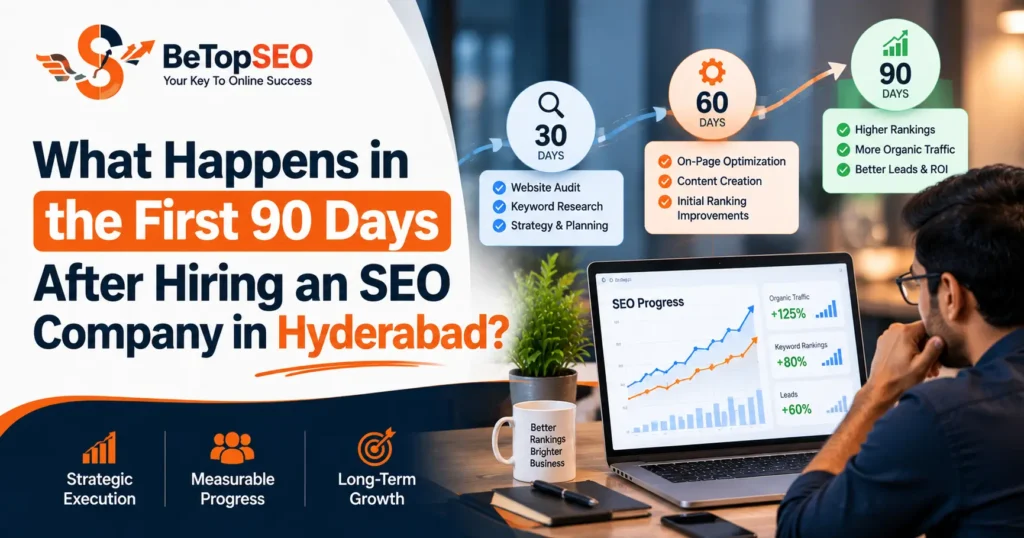
Days 1–30: Audit your website, understand your business, establish performance benchmarks, and prioritize SEO issues.
-
Days 31–60: Implement important technical fixes, improve key landing pages, and start focused content or local SEO work.
-
Days 61–90: Review early search signals, measure implementation, identify what is working, and refine the next-quarter plan.
-
Throughout all 90 days: Expect clear communication, measurable deliverables, and honest reporting—not guaranteed rankings.
What happens during the first 30 days after hiring an SEO company?
The first 30 days are usually about understanding the business, establishing a reliable baseline, and finding the issues that could limit organic growth. Your SEO partner should turn its initial findings into a prioritized action plan rather than simply sending a long list of errors.Week 1: How does the SEO company understand your business?
Before changing website titles or publishing blogs, the SEO team needs to understand what your business sells, who your customers are, and which enquiries matter most. For a Hyderabad business, this may involve discussing:-
Your main products or services and the locations you serve.
-
Your most profitable services and highest-value customers.
-
The searches potential customers use before contacting you.
-
Your main competitors in Google Search and, where relevant, Google Maps.
-
Existing website traffic, enquiries, calls, and conversion tracking.
-
Previous SEO work, website redesigns, or recent ranking changes.
Week 2: What does an SEO audit include?
A website audit helps identify what is preventing important pages from performing well in search. The team should evaluate issues based on their likely impact, not just the number of warnings generated by an SEO tool. Common areas include:-
Technical SEO: Crawlability, indexation, redirects, broken links, site speed, mobile performance, and sitemap configuration.
-
On-page SEO: Page titles, headings, content relevance, internal links, and search intent.
-
Content quality: Thin pages, outdated information, overlapping topics, and missing answers to customer questions.
-
Local SEO: Google Business Profile information, location relevance, reviews, and local landing pages, where applicable.
-
Competitor analysis: Topics, service pages, and search opportunities competitors cover more effectively.
-
Conversion tracking: Whether calls, forms, purchases, or other important actions can be measured reliably.
Week 3: How are SEO keywords and target pages selected?
Once the team understands your website, it should map relevant searches to the pages best suited to answer them. This helps prevent multiple pages from competing for the same search intent. For example, a Hyderabad-based accounting firm may need separate pages for its core accounting services, tax consulting, and industry-specific offerings. A single generic page may not answer all those needs well. The SEO team should identify:-
High-intent service and product searches.
-
Informational topics that help potential customers make decisions.
-
Location-specific searches, if local customers are important.
-
Existing pages that can be improved instead of creating duplicates.
-
Content gaps that deserve new pages or articles.
Week 4: What should you receive by Day 30?
By the end of the first month, you should normally have a clear view of the website’s current condition and the campaign’s priorities. Depending on access, website size, and the agreed scope, some initial fixes may already be completed.Day 30 deliverables checklist
0 of 6 checkedWhat should an SEO company do during Days 31–60?
The second month typically shifts from discovery toward implementation. Your SEO team should begin addressing the most important issues and improving the pages with the strongest potential to attract relevant customers.Which technical SEO issues should be fixed first?
Technical fixes should follow the priorities established in the audit. If important service pages cannot be indexed, resolving that issue may be more urgent than publishing several new blog posts. Depending on the website, the work may include:-
Resolving accidental indexing restrictions or crawl barriers.
-
Fixing broken internal links and unnecessary redirect chains.
-
Improving mobile usability and page performance.
-
Correcting canonical or duplicate-page problems.
-
Reviewing XML sitemaps and robots directives.
-
Improving internal navigation so important pages are easier to find.
How are important service pages optimized?
A service page should make it easy for both search engines and potential customers to understand what you offer, who you help, and what action to take next. For a business targeting Hyderabad, that may mean refining the page title and headings, improving the explanation of services, answering common buyer questions, adding relevant internal links, and making the contact process clearer. Good on-page work is not about repeating “SEO company in Hyderabad” as many times as possible. It is about aligning the page with the searcher’s intent and giving them useful, specific information. Your agency may also improve:-
Calls to action and enquiry forms.
-
Service descriptions and supporting evidence.
-
FAQs based on genuine customer questions.
-
Links between related services and educational articles.
-
Relevant images, descriptive alt text, and page structure.
When does content creation begin?
Content planning should begin early, but publishing usually follows the audit and keyword-to-page mapping. During Days 31–60, the team may update existing content, prepare new service pages, or publish articles that answer relevant customer questions. A useful content plan connects each topic to a clear purpose:| Content type | Purpose | Example for a Hyderabad business |
|---|---|---|
| Service page | Reach customers actively looking for a solution | SEO services for healthcare businesses |
| Informational article | Answer a question during research | How local SEO helps clinics attract nearby patients |
| Comparison page | Help customers evaluate options | In-house SEO vs. hiring an SEO agency |
| Local landing page | Explain genuine service coverage in a location | A dedicated service page for a real Hyderabad service area |
What if your business depends on local customers?
For clinics, restaurants, home-service providers, professional firms, and other businesses serving nearby customers, local SEO may be a key part of the second-month plan. The work may include reviewing the accuracy and completeness of your Google Business Profile, improving local relevance on the website, checking business details across relevant directories, and developing a sustainable approach to earning genuine customer reviews. A business should not expect an agency to promise a particular Google Maps position. Local results can vary by the searcher’s location, the query, and the competitive environment. Learn more about local SEO services in Hyderabad.What should you see by Day 60?
By the end of the second month, you should be able to see what has actually been implemented and what remains outstanding. Depending on your agreement, this may include a record of technical fixes, revised service pages, published content, local SEO improvements, and a list of remaining dependencies. You may also begin to notice changes in search impressions, the queries for which your pages appear, or clicks from relevant searches. These are useful signals, but they do not guarantee that enquiries or revenue will increase immediately. If a developer, internal marketing team, or business owner must approve changes, the report should identify those dependencies. Delayed implementation can affect the campaign timeline.What happens during Days 61–90 of an SEO campaign?
The third month is about evaluating the work completed, studying early performance signals, and deciding what deserves attention next. By this stage, you should have a more concrete understanding of the campaign’s direction—even if it is too early to judge its full commercial impact.How does the SEO team measure progress?
A good report connects search performance to business objectives. It should distinguish between work completed, changes in search visibility, website engagement, and actual conversions. Useful measurements include:-
Search impressions: How often your pages appear in Google Search.
-
Organic clicks: How many people click through from Google Search.
-
Relevant search queries: Which terms are bringing visibility to the site.
-
Landing-page performance: Which pages attract organic visitors.
-
Conversions: Enquiries, calls, purchases, bookings, or demo requests, where tracking is available.
-
Local performance: Relevant Google Business Profile interactions and local enquiries, when applicable.
-
Implementation progress: Which recommendations have been completed, tested, or are still waiting.
Should your rankings improve within 90 days?
Some websites show early improvements within the first three months, while others need longer. Results depend on factors such as the website’s existing authority, technical condition, competition, content quality, implementation speed, and the type of search terms being targeted. A newer website competing in a crowded Hyderabad market may need more time than an established site with strong content and a few fixable technical issues. By Day 90, useful progress may include better indexation, more visibility for relevant queries, improved landing pages, stronger local information, or early growth in qualified organic visits. These are possible outcomes, not guaranteed milestones. An agency that promises a fixed ranking or a specific number of leads by a certain date without considering your starting point is giving you a reason to ask more questions.How should the SEO strategy change after reviewing the data?
The first 90 days should produce better information for the next phase of work. Your SEO team can use the findings to prioritize pages that are gaining traction, investigate pages that are underperforming, and adjust content or technical priorities. For example, if a service page begins receiving impressions for relevant searches but attracts few clicks, the team might review its title and search-result presentation. If organic traffic increases but enquiries do not, the problem may involve search intent, the landing page, the offer, or conversion tracking—not rankings alone. The point is to make informed changes rather than continue the same activities regardless of the results.What should your SEO company report at the end of 90 days?
Your 90-day review should explain what was planned, what was completed, what changed, and what happens next. It should also separate measurable results from work that is still in progress. A useful review includes:What if you see no improvement after 90 days?
Limited movement does not automatically mean the SEO campaign has failed, but it should lead to a specific review of the evidence. Your agency should be able to explain what has been implemented, whether Google can access the important pages, which search signals have changed, and what is holding the campaign back. Start by asking these questions:-
Were the agreed tasks completed? Separate completed work from recommendations that were never implemented.
-
Are the important pages indexed? Check whether Google can discover and index the pages intended to rank.
-
Are we targeting relevant searches? Confirm that the keywords match your services, customers, and locations.
-
Are impressions changing even if clicks are not? Rising impressions can indicate emerging visibility, while weak clicks may point to a mismatch in the page title, snippet, or search intent.
-
Are conversions being tracked correctly? Missing or broken tracking can make a campaign look ineffective—or successful—without reliable evidence.
-
What will change in the next 30–60 days? Ask for a prioritized plan with reasons, responsibilities, and realistic expectations.
How does BeTopSEO approach the first 90 days?
BeTopSEO’s SEO offering for Hyderabad businesses covers technical SEO, on-page improvements, local SEO, content strategy, and AI-search readiness. The right mix depends on your website, target audience, business goals, and the scope of work agreed at the start. A practical campaign should begin with an audit and baseline, move into prioritized implementation, and use reporting to guide the next set of improvements. Some businesses need to resolve indexing and website issues first; others may need better service pages, stronger local visibility, or content that answers high-intent customer questions. For an overview of the available services and approach, visit BeTopSEO’s SEO company in Hyderabad page. If you are comparing proposals, ask each provider to explain what it will do in the first month, which tasks it expects to implement in the second, how it will assess early performance in the third, and what it needs from your team. That conversation is often more useful than comparing keyword counts or promises of guaranteed rankings. Want a clearer plan for your website? Contact BeTopSEO through its SEO services page to discuss your goals, current challenges, and the priorities that make sense for your business.Final takeaway: What should you expect after hiring an SEO company in Hyderabad?
The first 90 days should give you a stronger website foundation, a clearer content and keyword strategy, visible progress on agreed tasks, and a reliable way to measure search performance. They should also help you understand which opportunities deserve further investment. SEO is a process of investigation, implementation, measurement, and refinement. The best early sign is not a dramatic ranking claim; it is a campaign where the work is transparent, the decisions are evidence-based, and the next steps are clear. If your SEO company can show you what it has done, explain what the data means, and connect its priorities to your business goals, you have a more useful basis for judging the partnership.FAQs: First 90 Days With an SEO Company
SEO timelines vary by website condition, competition, content quality, and implementation speed. Some technical or indexing improvements may become visible relatively quickly, while stronger ranking and lead-generation results can take longer. The first 90 days should establish a baseline, address important issues, and reveal early performance signals, not guarantee a specific ranking.
The first month should normally include business discovery, access and tracking checks, an SEO audit, keyword and page mapping, baseline reporting, and a prioritized action plan. Depending on the website and agreed scope, the agency may also implement urgent technical or on-page fixes. Deliverables should be documented so you can see what has been completed.
You may see more qualified enquiries within three months, but it is not guaranteed. Lead growth depends on whether the website attracts relevant visitors, whether its pages meet their needs, how competitive the search terms are, and whether conversion tracking works. Evaluate organic visibility and lead quality together rather than relying on traffic totals alone.
Most businesses benefit from a monthly performance report and regular communication about implementation, blockers, and upcoming priorities. Complex campaigns may need more frequent check-ins. Reports should compare results with a baseline, explain significant changes, identify completed work, and set out next steps. The reporting frequency should be agreed before the campaign starts.
No responsible SEO provider can guarantee a specific Google ranking within 90 days. Search results depend on competition, relevance, website quality, and systems outside an agency’s control. A credible provider should explain its strategy, deliverables, measurement process, and risks. Be cautious of guaranteed positions or lead volumes that are not supported by evidence.