
Table of Contents
ToggleKey Takeaways: What multi-location businesses should know
- Every branch needs accurate, up-to-date business information and an appropriate local search strategy.
- Location pages should provide genuinely useful details about each branch, not just swap city names in duplicate copy.
- Google Business Profiles must follow Google’s real-world business representation rules.
- Reviews, local relevance, mobile usability, and clear contact options all contribute to a better customer experience.
- Measure calls, direction requests, forms, bookings, and qualified enquiries by location—not just website traffic.
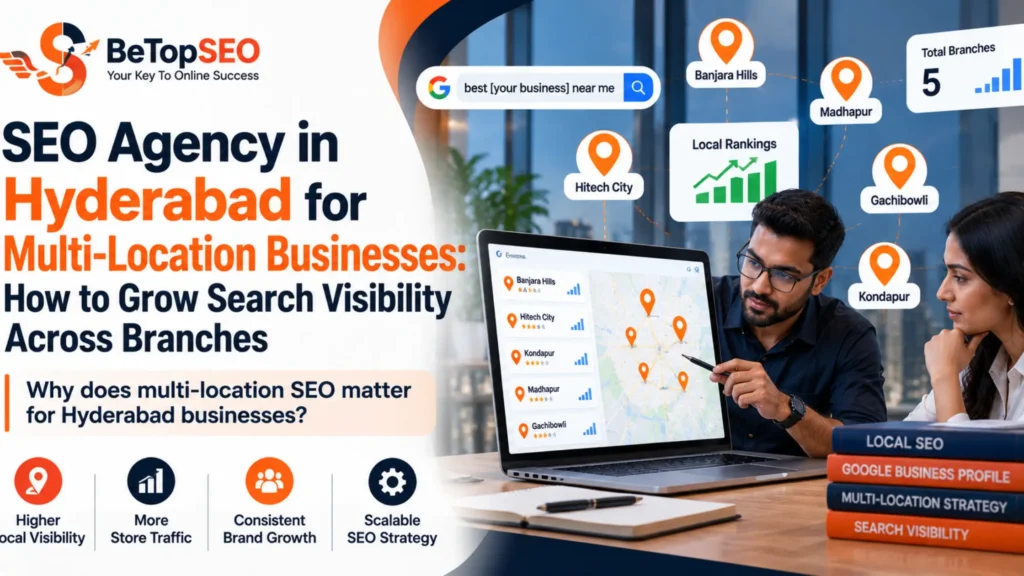
Why does multi-location SEO matter for Hyderabad businesses?
Multi-location SEO helps customers discover the branch that is most relevant to them when they search for a nearby service, shop, clinic, institute, or office. For businesses serving different parts of Hyderabad, a single homepage may not adequately answer every local customer’s questions. Imagine a customer searching for a dental clinic near Gachibowli or a training institute in Kukatpally. They want to know whether a suitable branch exists nearby, what services it provides, how to reach it, and how to contact the team. If your website only lists a general company address, that customer may struggle to find the right information. A well-planned multi-location strategy connects three elements:- Local discovery: helping customers find relevant branches through Search and Maps.
- Branch-specific information: providing accurate services, addresses, opening hours, and contact details.
- Conversion: making it easy for visitors to call, book, request directions, or submit an enquiry.
How can an SEO agency in Hyderabad improve visibility across multiple branches?
An SEO agency can coordinate your website, local listings, technical setup, and reporting so each eligible branch has a clear online presence. The strategy should reflect your actual locations, customer needs, services, and competition—not simply target every nearby locality with another page. A practical approach includes the following steps.1. Build a clear local SEO plan for each branch
Start by mapping every branch to its real address, services, operating hours, service area where applicable, and intended customer audience. Next, identify the searches that matter to each location. A multi-branch clinic, for example, might need service-related pages as well as useful location information. A retail chain may need store details, product categories, directions, and branch-specific contact options. The objective is to establish a sensible relationship between each location, the services available there, and the pages customers should find.2. Optimize Google Business Profiles correctly
Google Business Profiles can help eligible physical locations appear in relevant Google Search and Maps experiences. Each profile should accurately represent the business and the location it serves. For eligible multi-location businesses, review:- The real-world business name and appropriate primary category.
- The correct street address or eligible service-area setup.
- Opening hours, holiday hours, and contact details.
- The website or location page that represents the branch.
- Relevant photos and accurate service information.
- Customer reviews and appropriate responses.
3. Create useful, branch-specific website pages
A dedicated page for each real branch can help customers find practical information and can support relevant local search visibility. However, every page needs a reason to exist beyond including a different locality name. A useful location page may include:- The branch’s complete address and directions.
- Services actually available at that branch.
- Opening hours and relevant contact details.
- Genuine photographs of the location, team, or facilities.
- Branch-specific frequently asked questions.
- Nearby landmarks or access information when helpful.
- A clear call, booking, or enquiry option.
4. Strengthen the technical foundations
Even useful location content needs to be accessible to search engines and easy to use on mobile devices. A technical review should check whether:- Location pages can be crawled and indexed where appropriate.
- Internal links connect the main location directory to individual branch pages.
- Pages load reliably on mobile devices.
- Canonical tags and redirects are configured correctly.
- Important branch information is available as visible page content.
- Relevant structured data matches the information users can see.
What should a multi-location SEO strategy include?
A strong strategy should cover more than Google Maps. It should help customers discover the business, evaluate the correct branch, and take the next step without confusion.| SEO component | What to do | How to assess progress |
| Google Business Profiles | Maintain accurate details for eligible branches | Profile interactions, calls, direction requests |
| Location landing pages | Provide genuinely useful information about each branch | Relevant organic visits, enquiries, conversions |
| Local keyword research | Match searches to actual services and locations | Search impressions, clicks, relevant rankings |
| Reviews and reputation | Encourage honest feedback and respond professionally | Review activity, recurring feedback themes |
| Technical SEO | Improve crawlability, mobile experience, internal linking, and page quality | Indexing, technical issues, page experience |
| Conversion optimization | Make calls, bookings, and enquiry forms easy to use | Conversion rate, qualified enquiries |
| Reporting | Segment performance by branch | Leads, bookings, and business outcomes per location |
How do you prevent duplicate content across location pages?
Location pages should answer the questions customers have about the specific branch, rather than repeat nearly identical content across multiple URLs. The right approach is to use a consistent page structure while adding meaningful, verified information that differs by location. Consider a company operating in Madhapur and Gachibowli. Useful approach Madhapur branch page Include its actual address, services offered, parking or access information where relevant, branch contact details, genuine photographs, and questions customers commonly ask about that location. Useful approach Gachibowli branch page Include the correct branch details, available services, appointment process, access instructions, and other verified information that helps a customer choose or visit this branch. Avoid Two nearly identical pages Repeating the same sales copy, headings, FAQs, and service descriptions while replacing “Madhapur” with “Gachibowli” creates a weak experience and may resemble doorway-page tactics when used to manipulate search results. A template is perfectly reasonable for maintaining consistency. The important distinction is that the information on each page should be accurate, relevant, and useful. There is also no need to create a separate page for every neighbourhood automatically. If the business does not have a real branch there, a genuinely useful service-area page may sometimes make sense—but it should not imply a physical location that does not exist.How should reviews support local SEO across branches?
Reviews help prospective customers assess the quality and suitability of a business. A branch-level reputation process also helps management spot service issues that might otherwise be hidden in company-wide feedback. A practical review process should include:- Invite customers to leave honest feedback after a genuine interaction.
- Use the correct, eligible business profile for the branch they visited.
- Respond professionally and address concerns without exposing private customer information.
- Look for recurring feedback about service, communication, availability, and customer experience.
- Share relevant feedback with the teams responsible for improving each location.
How can an SEO agency measure results by branch?
Branch-level reporting should show which locations attract relevant searches, which pages encourage action, and where customers encounter problems. This is more useful than a single report showing only total website traffic. A practical measurement framework includes four layers.- Search visibility
- Customer actions
- Lead quality
- Business outcomes
Example: What might a multi-location SEO improvement look like?
Consider a hypothetical Hyderabad-based diagnostic business with three branches. Its website lists all three addresses on one general contact page, while the branch information on Google is incomplete. A structured improvement plan might look like this: Stage 1: Audit the current setup Confirm branch eligibility, profile accuracy, service availability, website indexation, and the consistency of contact details. Stage 2: Improve local information Correct eligible profiles, create or improve useful branch pages, and connect those pages through a clear location directory. Stage 3: Fix technical and conversion issues Check mobile usability, indexing, page links, appointment options, and enquiry tracking. Stage 4: Review branch performance Compare relevant search traffic and enquiries, identify weaker locations, and prioritize improvements based on evidence. This is an illustrative scenario, not a BeTopSEO client case study or a claim of measured results. Actual outcomes depend on the starting point, competition, branch eligibility, demand, implementation, and customer experience.When should you hire an SEO agency in Hyderabad for multiple locations?
An agency may be useful when internal teams struggle to keep branch information consistent, when different locations perform unevenly in search, or when website visits are not translating into qualified enquiries. Before engaging a partner, ask whether its approach includes:- A review of all existing branches and local listings.
- A clear plan for location pages and internal linking.
- Technical SEO checks and content quality standards.
- A process for reviews and accurate business information.
- Branch-level reporting tied to business objectives.
- A realistic schedule for implementation and review.
- Clear communication about priorities, risks, and what the available data can prove.
How can BeTopSEO support a multi-location SEO strategy?
BeTopSEO can be considered by businesses that need to coordinate local SEO, website optimization, technical improvements, and performance reporting across multiple branches. The appropriate scope depends on the business model, number of locations, existing website, and the outcomes the company wants to improve. A sensible starting point is to identify which branches need attention first, what is preventing customers from finding or contacting them, and which improvements can be measured reliably. Explore these resources: Planning to improve visibility across your branches? Contact BeTopSEO to discuss your business locations, current search visibility, and opportunities to generate more relevant enquiries. Start with a clear assessment rather than committing to a long list of SEO activities without knowing which problems need solving.Multi-location SEO: FAQS
Multi-location SEO is the process of improving a business's visibility in search results across its eligible physical branches or service areas. It typically involves accurate business profiles, useful location pages, local keyword research, technical SEO, reputation management, and branch-level performance measurement. The goal is to help customers find the right location and take a meaningful next step.
Not every branch automatically needs a separate page, but a dedicated page can be useful when it provides meaningful information about a real location. Include accurate branch details, services, contact options, and other information that helps customers. Avoid publishing large numbers of nearly identical pages that differ only by the neighbourhood name.
A business with multiple eligible physical locations will generally need an appropriate profile for each distinct location, following Google's policies. A profile should represent a real, eligible business location and contain accurate information. A business should not create duplicate profiles for the same location or use virtual offices to simulate additional branches.
There is no universal timeline. Results depend on the site's existing condition, competition, location demand, technical issues, content quality, and implementation. Some improvements to business information can be made quickly, while meaningful organic visibility changes may take longer. Review progress consistently and evaluate search performance alongside qualified enquiries and business outcomes.
Measure performance at both the website and branch levels. Relevant indicators include organic clicks, local profile interactions, calls, direction requests, bookings, enquiry forms, and qualified leads. Where possible, connect these actions to CRM records or sales outcomes. Use consistent reporting periods and document attribution limitations so the business does not mistake every enquiry for an SEO-generated lead.
Local SEO helps a business appear for relevant searches in its geographic market. Multi-location SEO applies local SEO principles across several eligible branches, each of which may have different services, customer needs, competition, and performance. The challenge is coordinating these locations without creating duplicate content, inaccurate listings, or inconsistent reporting.
Branches can share core service terms, but their targeting should reflect the services actually available and the customers each location serves. A company should not force a different keyword onto every branch page just to create variation. Use keyword research to identify meaningful differences in search intent, then make each page useful for its intended audience.
Prepare a current branch list with addresses, phone numbers, operating hours, services, website URLs, and relevant Google Business Profile access. It also helps to provide website analytics, Search Console data, lead records, and any existing location-page content. This gives the SEO team a clearer starting point and helps establish realistic priorities.
BeTopSEO's SEO reporting should be evaluated against business objectives, not rankings alone. Relevant measures may include organic search visibility, qualified website traffic, calls, enquiries, bookings, and other conversions that can be tracked reliably. Ask for reporting that explains which activities were completed, what the data indicates, and which priorities should be reviewed next.
A useful strategy begins with the business's locations, audience, services, competition, website condition, and current performance. From there, priorities can include local listing accuracy, location-page quality, technical SEO, internal linking, and conversion tracking. The plan should be adjusted as branch-level data reveals where customers are finding the business and where they encounter friction.